I have been thinking a lot about friendship again lately due to another shift in my friendships and some tension as well. It has me questioning whether I have the wrong idea of what a friend should be, if I have unrealistic expectations, or if I will ever have the sort of friendships I’ve dreamt of in the past.
What friendship used to be
I grew up watching a lot of TV and I think this may have shaped my idea of friendships since then. Shows and films like Friends, How I Met Your Mother, Community, Avatar the Last Airbender, Harry Potter, One Piece and the like were my favourites and they all include a group of friends.
These weren’t just casual friendships either. They were ride-or-die friends. Loyal beyond expectation. See-each-other-every-day friends. In this day and age, that just doesn’t seem plausible. I don’t know anyone who lives this way anymore, where it’s the norm to see your friends (in adulthood) every day at a local coffee shop or bar or other third place. In a world where some people don’t even have a second place (they may work from home), it’s asking too much for some to have a third or fourth.
Childhood
It’s natural in childhood to see your friends every day because of school. You hang out on the playground or in the lunch room or library. You go over to each other’s houses after school. Sleepovers were the norm. “Playing out” or “calling for” a friend was natural. At least, that’s how I grew up. My mom was a single mother and so she relied on the help of others to support her three children. We were always at friends’ houses or our grandparents’ house or with our cousins.
Friendship and connection never felt forced.
In my teen years, I started to struggle with friendships because, perhaps, I became more self-aware. More self-conscious. Aware of who I am and how that compared to others. I felt I was close friends with the wrong people, so I felt I had to hide my true self. This hurt a lot and caused trauma. Social anxiety and depression creeped in, but cause and effect isn’t that simple to define, is it? What came first, I don’t know. But friendships suffered. I suffered.
The ease I had in childhood slipped away, and hasn’t been back since.
Modern life
Before I talk about what friendship can look like, I’ll touch on one last reason why friendship may feel different now. We live in a social media, online world. Whether you are active online or not (I slip in and out of phrases), the mere existence of social media can feel like a surrogate for connection. Some people feel like they are involved in their friends’ lives just because they like their posts and watch their stories; because they send endless memes and reels or because they see their face daily through a screen.
This is not the same as real connection
We may have lost what true connection is, because we are so entangled in social media. Social media can also expand your “social circle” because your followers and those you follow feel like a network or community, but in reality, they are not. Our brains don’t really know the difference. Seeing someone online may feel like seeing them in person.
Remember/ be cautious of:
- Social media is fake/a highlight reel – your friend may look happy online but is hiding something in reality
- Seeking validation and connection through a screen – likes feel like connection but it is short-lived and not fulfilling
- Spending time with friends in person but actually everyone is on their phones
- Let seeing someone’s social media post be a trigger to reach out for a phone call or catch up in person!
A model for friendship?
I saw this interesting TEDTalk about Friendship which used this diagram to demonstrate what true, lasting, fulfilling friendship looks like.
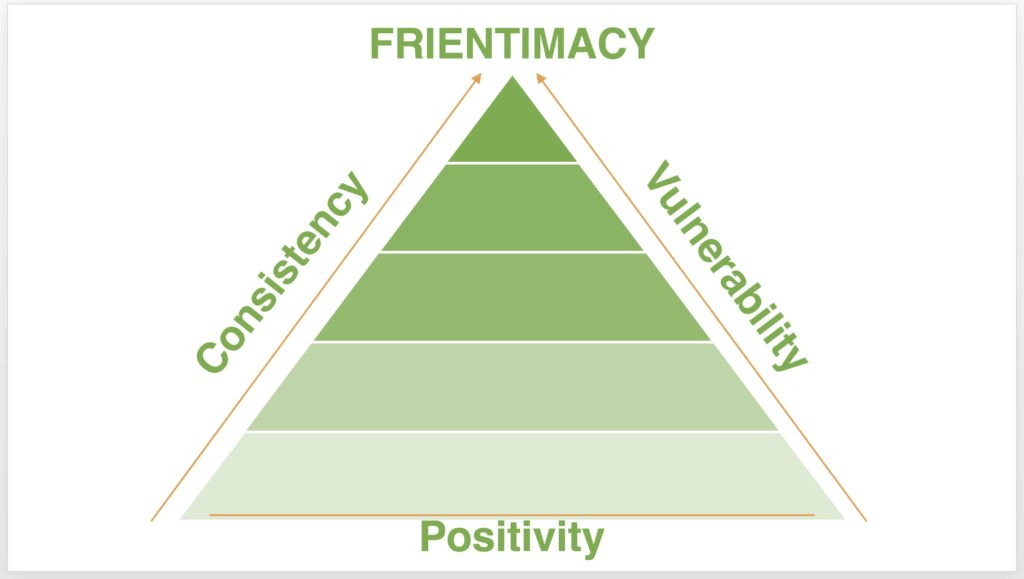
I can agree with this. Friendships feel better when there is consistency (regular and meaningful interactions), vulnerability (you can be open and honest; your true self), and positivity (you feel better, happier, good in their company). This seems to be a reasonable model for me. However, we have to look deeper to see what this actually looks like in practice.
How regular is regular enough to be consistent and fulfilling for us?
Is the vulnerability well-balanced? Not just trauma-dumping or oversharing, or the opposite where it’s one-sided vulnerability.
If a friend is struggling, surely they don’t need to make you feel positive? Things can’t always be rosy and that’s okay.
Friendships have life cycles
You can’t always expect to be friends forever with everyone you ever considered a friend! Childhood friends naturally slip away as you grow and change and move away from your hometown and take up new interests. Our priorities change over time. We go through life cycles of our own, different stages in life, and with that our friendships will change shape, too.
For example, a new mother whose friends aren’t mothers. She may seek out friends who are in the same stage of life to her now. Or friends who used to be drinking and partying friends, but you are now sober. Or friends from a sports team that you no longer enjoy. Or friends from an old job so you naturally don’t see them all the time anymore.
It’s only natural that these connections shift and change form.
Friends can serve different purposes
It’s also important to note that friends serve different roles sometimes.
- A work friend who you don’t necessarily see outside of work
- A friend you work out with
- A drinking buddy
- A friend who likes the same films, tv or books as you (you can watch together or talk about the books)
- An outdoorsy, active friend
- A go on holiday together friend
- A shoulder to cry on friend
- A chill in the house in PJs and not do much friend
- An artsy friend
- A friend into tarot card reading and journalling
- A friend to vent to
- A phone call only friend
- A once a month catch up friend
- A texting and memes friend
- A shared career or lifelong dream friend (like writing friends for me)
- A dog walking friend
- A catch up about old times infrequently friend
Can’t expect friendship to look the same for you as it does for them
This is a big one that I’ve learned recently. It’s based on something a colleague said when I discussed changing friends with them. They said that some people view friendship differently to you, and you can’t blame them or be angry at them for that, which is hard. I 100% agree with this and I think this is the leading cause of any friendship upset for me. I can have an expectation of what our friendship should look like, but they have another image, therefore there’s an imbalance.
Say I expect to receive messages from them weekly about random stuff or check ins, but they only expect to check in when there’s something to actually talk about (a life update, a change, a milestone, some news etc). Someone may expect to see each other once a month, but others want it more or less frequently.
No one should be your everything
Similarly, no one person should act as everything for you. It’s exhausting and unfair! A friend needs space too. They can’t be someone you lean on for every little thing. Someone you expect to meet all the needs and wants listed above. It’s okay, and healthy, to have various people fulfilling these roles. It’s less pressure and ensures friendships don’t burn out.
Figure out your boundaries and needs / expectations
So what can we do about it? Are we to just accept all of the above and work on ourselves? Our acceptance of shifting cycles, life stages, roles for friendship and opposing expectations?
Yes and no.
Yes, we must first accept. Be aware of what our current friendships look like and accept it for what it is:
- Who reaches out more for a conversation?
- Who carries the conversation?
- Who arranges the meetups?
- Who talks more about their problems?
- Who asks after the other’s wellness more?
- Who makes the most effort to meet up or converse or visit?
- How do you feel in their presence?
- How do you feel after they have left your company?
- Are there certain situations, places, or times when their company feels better or worse?
Once you have a clear idea of how your friendship looks, analyse it a bit. Sit with your findings. How does it feel? Is this fair for you (or them)? Does it feel good? Is the friendship fulfilling and meaningful for you? Do you think you’re being a good friend by your own standards?
Then, communicate your wants and needs from the friendship. As long as you’re fair, kind and reasonable, any true friend shouldn’t feel attacked or angry about you voicing an imbalance or tension in the friendship.
“I feel like I am reaching out to you more than you do to me, and that hurts a little as I feel like you don’t think about me as much as I think about you”
“Is there a way we could make our friendship stronger? Could we put a regular thing in the calendar that serves us both?”
“How much time and energy do you have right now for our friendship? I would like to know so I can manage my expectations”
Tend to your friendship – regular maintenance checks is key
Remember that friendships are relationships. They take work! They take healthy and intentional communication to navigate. You have to choose them. Honour their changes. Grow together. Learn together about what one another wants and needs.
Honest and open conversations as listed above can be uncomfortable and awkward at first, but if you find you are struggling in your friendships, maybe this is something you need.
Make tending to the friendship simple: have a monthly catch up that’s always on the calendar for you both and is non-negotiable. Do an activity together so you naturally see each other: I’ll see you at the weekly Saturday morning park run! Keep a note somewhere reminding you to check in. Maybe you could do the grocery shop together? One work out a week together? A weekly phone call while you walk the dog.
New friends? Expanding the net?
I already did a post about how to make friends in adulthood, if you want to check that out. I will add here that you shouldn’t be afraid to reach out to new people. Be brave and slide into their DMs! If you’ve joined a club or do park runs or pick up your kids from school or daycare, reach out and say hi to someone new. They could be a great friend waiting for you!
Also, don’t be judgmental. There could be someone out there who you wouldn’t usually mingle with who could change your life. One of my best friends is someone who had slightly different religious and political views to me, but in creating a meaningful friendship, she has said she’s learned so much from me and opened her mind to new ideas.
Lastly, remember that friends may be hiding in plain sight: your siblings, a parent, your spouse or partner, that woman you think is cool from your park run, your colleague you’ve been too scared to ask to meet up with outside of work. My best friend is my husband. My brother and sister have been best friends since childhood (though naturally our friendship has changed shape as we’ve grown up). And that’s okay. It’s not weird at all!
If you’re feeling lonely or unsure in your friendships, I assure you, you’re not alone. Sending love and positive friendship vibes your way!
Sincerely,
S. xx

 S. R. Crawford