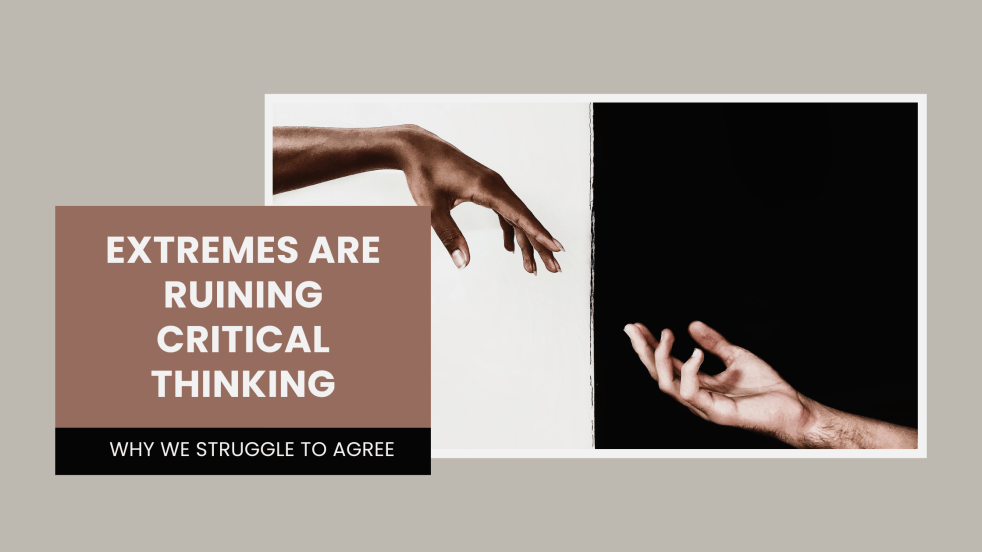
I’ve been watching the YouTube channel Jubilee and it’s segment Middle Ground for a few weeks now and I find it fascinating seeing opposing sides discuss difficult topics. A recurring thing I’ve seen though is people using extremes to combat opposing sides when I think this is immature, goes against critical thinking, and removes our ability to find common ground (which I believe isn’t as hard as many make it out to be).
I strongly believe that extremes are the problem because people mistake them as representing the whole. That if one event, person or conversation states an extreme view, then they must be speaking for or representative of all others who come under the same bracket. For example all Christians believe in ethnic cleansing. Or all feminists believe in the erasure of men. These are extremes that do not embody the ideology of all who identify with the title or community or belief system.
I am pro choice. As in, I believe people should be able to live their life however they choose. Maybe more accurately, I should say that no one should feel forced to live their life a certain way that goes against their personal fulfilment. However, as soon as I say this, people who disagree with my views would use an extreme against me…
“So you think it’s okay for people to murder people just because they want to?”
“So you think it’s okay for paedophiles to abuse children because they want to?”
“So you think it’s okay for rapists to abuse because they want to?”
“So you think it’s okay to abuse benefit systems because you want to?”
No.
No.
No.
And no.
A lot of people would also argue that my beliefs are selfish. That people should set aside their personal wants and beliefs to serve a greater purpose and service to society. But then I also think, well which society? Who’s idea of society? Who is benefitting from the current norm or historic norms? Why were certain systems put in place? Also, I can agree to an extent but rather than use the word selfish which has connotations of cruelty or dismissive attitudes towards others, I would maybe use the word self-caring, maybe. Or perhaps we could coin a term like self-forward? Pro-self-actualisation?! Why should it be negative to care about yourself and personal fulfilment?
Because I don’t agree with an wholly individualistic, capitalist, every man for themselves society either! I feel sad that in the West we have lost the idea of community. I feel we are lonely. I believe we need others and we need to sometimes put others first or serve a wider community than just ourselves. I just don’t think people should make themselves miserable, in danger, unhealthy, or conflicted in order to do that.
It doesn’t truly serve society if the individuals coming together to make the whole are miserable and unwell while in service
This is my issue with so many discussions. People are too quick to use extremes to prove their point or “rightness” over someone on the opposite side. More people would actually find a middle-ground if they took a breath and stayed away from extremes of any kind.
The definition of an extreme is something that is polarised. That is on the far left or far right of a spectrum. Something, also, that is an anomaly. Something that is a small population or amount compared to the others who land somewhere on the spectrum between.
And before anyone comments on this, I am not saying that the issues only lie with far right ideology. This includes far-leftists. Anyone who holds extreme views with little to no nuance. Anyone or anything that is very narrow-minded and inflexible with their thinking or engagement. Because some communities are quick to dismiss allies because they don’t necessarily agree with every little thing they believe, which is counterproductive and harmful to progress for those communities.
Extremes are always used as examples because they are low-hanging fruit. They are an easy go-to for quotes. They are clickbait. They sell.
There are lifestyle extremes that are popular online now, like the Red Pill Manosphere Bros and Trad Wives. There are also extremes in progressive and supportive movements like Feminism and LGBTQ+ Allyship. There are extremes in religions, where people kill in the name of their God or cause harm because they have read scripture in a way that they felt advocated for that. Extremes are everywhere and I think it is damaging for us to use extremes as examples in conversations about political and humanitarian conversations.
Or rather, to be so quick to use extremes to make a point or relying only on the extremes for your evidence.
What could be the solution?
Steer clear of these extremes and deductive reasoning to improve your discussion
Two plus two equals four but in the world, in life, in humanity, things are not that simple. Just because a Muslim Pakistani man killed a group of women does not then mean all Muslim Pakistani men are violent. Just because a man pretended to identify as a woman in order to abuse women in the bathrooms, does not all people who identify with this way are violent and have unjust and corrupt intentions. White people commit crimes too, does that mean all white people do? Cisgendered (identify with their biological sex) people commit crimes, lie, and abuse too, does that mean all cis people do?
Come on, use your logic here to a fair and reasonable conclusion!
For example, from things I hear a lot:
- “Foreigners are dangerous to our women and children, as it is reported that they have committed many atrocities in the UK”
- “So you think it’s okay for young children to mutilate their bodies just because they feel wrong in their body? That’s barbaric.”
- “Women aren’t safe with biological men in their prisons or refuges, evidence shows they have been attacked”
Yawn, get some new ideas and less extreme cases to support your viewpoint.
Don’t be afraid to agree!
I think many of us are afraid to agree with someone who holds different beliefs to us because we think that it means we have lost. Or that our own views are wrong. Or the other person is smarter than us. Or they argue/debate better than us. Or that we now need to change our whole worldview! None of these are true (at least, not entirely; it depends).
Instead, agreeing with someone when they demonstrate a perspective that you hadn’t considered before or that aligns with parts of your own truth shows intelligence. It shows maturity. It shows honesty and integrity. It shows real strength! I admire anyone who can do this easily, as I still struggle with it at times.
Be careful of online extremes becoming your view of a whole population
Again, what we see online is firstly just based on an algorithm and an echo chamber. We are shown what we like or engage with, not the whole story. We are also shown what is clickbait and engaging and eye-catching, not necessarily the whole truth. Journalists have been doing this long before social media, and it’s more so an issue now. Misinformation and disinformation are widespread and taken as fact.
Use your critical thinking skills to question what you see. Who is sharing this? What might they gain from sharing it? Who is it serving? What may it have missed? Who might disagree with this? What are others saying about this? Is it a true representation of all people (I guarantee it’s not!).
No one person represents everyone in that group!
Fact check
It takes longer, it’s not fun, but before you decide something definitively and base passionate arguments on an ideology or standpoint, back yourself up with facts. Too many people argue from a place of emotion and ignorance which is a toxic combination! Any time you find yourself being completely inflexible and rigid in your thinking, seek evidence, explore other perspectives, and fact check your line of thinking.
Social media is not a reliable source. World leaders are not a reliable source *cough cough Trump cough cough*.
Careful of conspiracy theories. No one is trying to turn all boys into girls! Immigrants aren’t trying to steal our country (the irony is sad but hilarious). There is no turning back the clock to a better country, nostalgia is a symptom of a hopeless nation and a selling point and weapon used by the far-right and fascism (a good book on this is On Tyranny by Timothy Snyder.
Have the hard conversations
I know people in my life who have different views to me. I find it really hard to have conversations where we will disagree because any form of conflict (or perceived conflict) makes me anxious and gets my emotions right to the edge! I get upset and cry easier. I fumble over my words. I say things I may not mean. I have a lot of work to do.
But this is the point: we all can work on doing this better. Navigating discomfort and disagreement until we can do so creatively, kindly, fairly, justly, intelligently, and critically.
Practice makes perfect.
Don’t be afraid to say “I didn’t mean that, let me try again” or “I hadn’t formed a view on that yet, please explain your viewpoint and I will consider this”. Allow yourself to be new to a topic. Allow yourself to explore and change your mind. And allow others to do so!
Happy critical thinking, folks!
Sincerely,
S. xx


