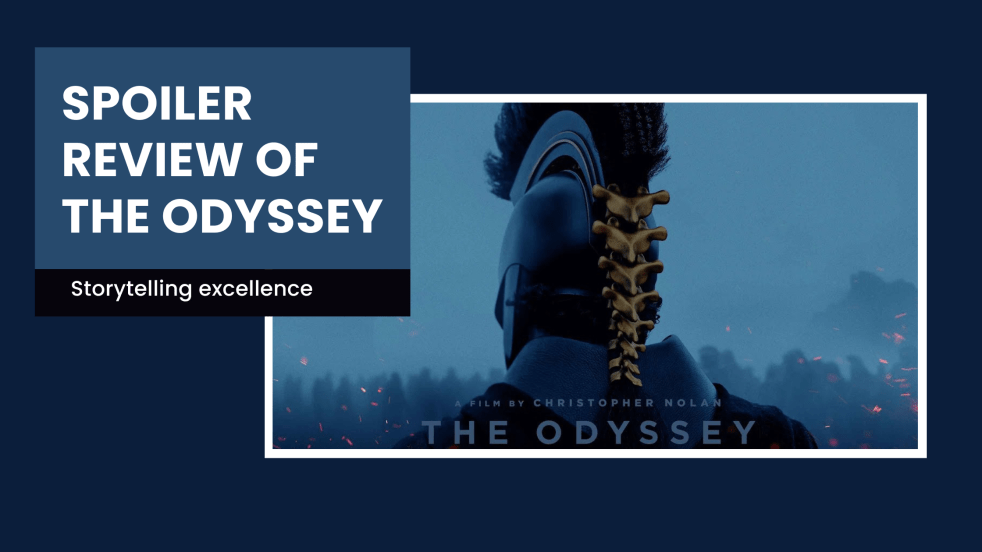
If you haven’t watched the film, please read my NO SPOILER review here! If you have watched it, let’s get into it!
This is my thoughts on the film in various parts. I watched it last night, so these are initial thoughts and feelings. I think it’s the kind of film that context changes: discussing it with others, reading the poem, watching film reviews on it, an academic’s point of view, a Greek myth expert point of view, a rewatch, Christopher Nolan lovers versus Nolan haters etc etc.
So this is my uncomplicated take. What I loved and noticed. Why I enjoyed the film thoroughly!
The Nolan of it all
Christopher Nolan has a GREAT director backlist:
- The Dark Knight / Batman (Heath Ledger one)
- Interstellar
- Inception
- Oppenheimer
- Memento
- Dunkirk
- Tenet
I mention Nolan first only because his name as the director carries a lot of weight. People will see films just because he directed them, or avoid them because he did! Either way, I see him as a great director. A competent and clever director who I trust to deliver a weighty film with a lot to say visually and from a storytelling perspective. Below is a video I watched after watching the film, and so if you’re a Nolan fan, this may be of interest to you, too, as it critiques the film from a more technical lens and focuses on production.
Trojan horse scene
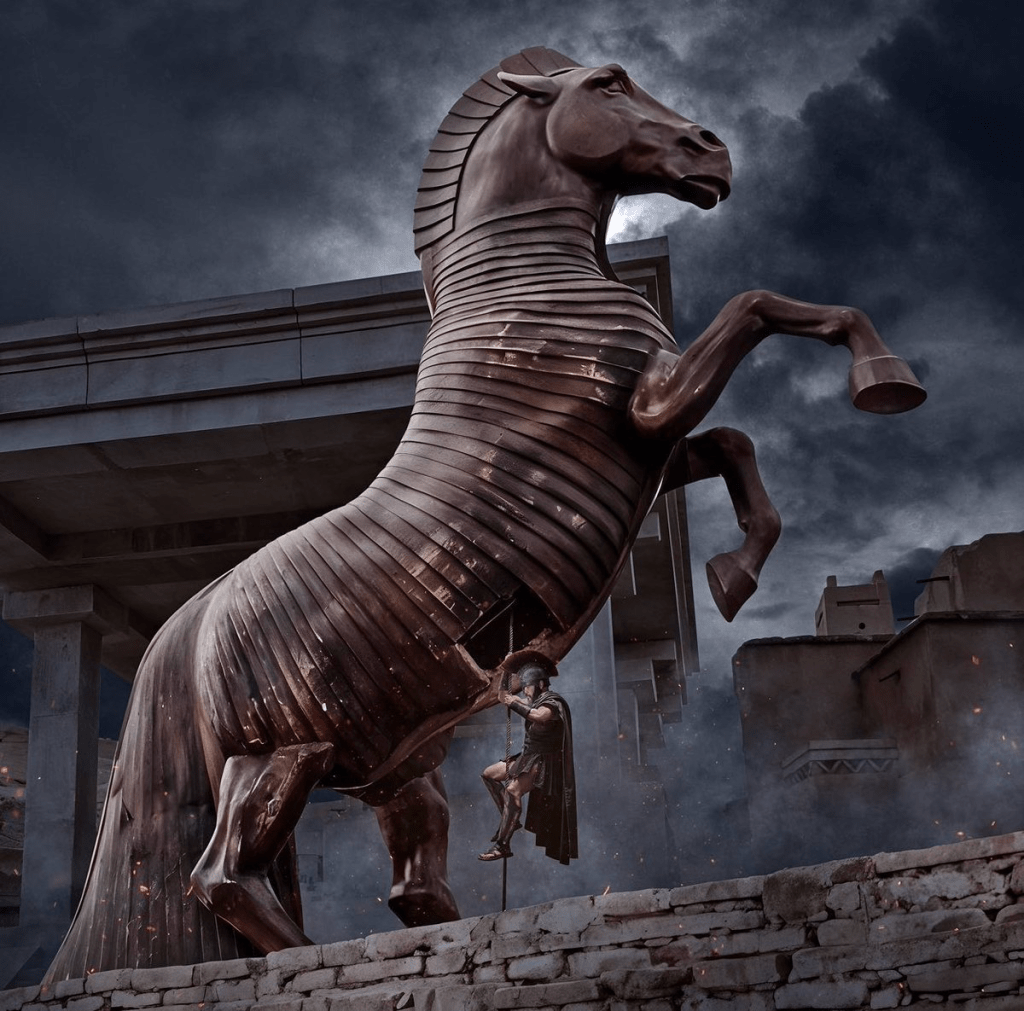
Most of us have heard of the Trojan horse tactic that won the war in Troy, but maybe we haven’t seen it in such a powerful scene as this, right? For me, it was extraordinary. As if experiencing the idea for the first time. So clever, so awful, brilliant! The claustrophobia and reality of being trapped in there for days together, peeing and pooping on one another, the tide coming in and drowning those at the bottom, wow.
Then when they were inside and it was erected like a statue of the Gods, what a clever then twist later for this to be linked to the statue of Athena which was destroyed (beheaded). That they were defying and disgracing the gods with this move. Abusing Zeus’s law (more on that later) with an offering taken as a sacred gesture that was then used in malice.
Perfection.
And I mean the look of the horse! The grandness…wow
Cyclops scene
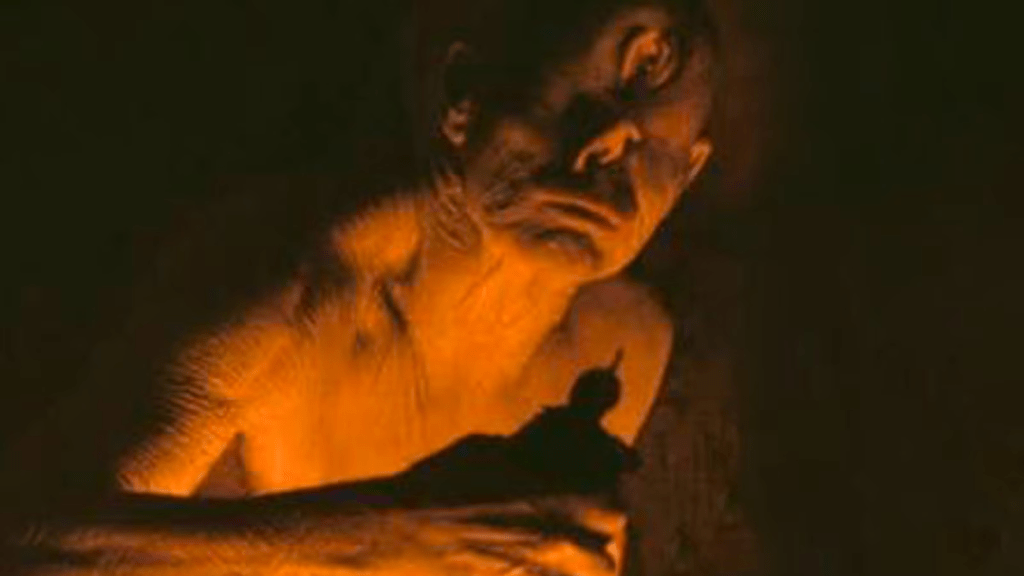
This blew me away. I’ve seen many interpretations of cyclopes before but this one will stand out above the rest for a very long time. There was no cartoonish huge round eye which is usually employed. No giant, fat, gangly oaf. Instead, the cyclops was horrifying!
The option to make it more humanoid was essential in making the scene bone-chilling. It hits in a unique way because it looks like a man, just a grotesque man of humongous stature.
Nolan took his time with this scene, of which I loved. Seeing them try tactic after tactic, and seeing how it failed, then adapted: that is real war. That is true intelligence. Not everything working out first time. Not a clever plan coming after one failure. But again and again facing the issue and getting closer but still so far away.
Odysseus’s love for his men was evident in this scene and increasingly was tested throughout the film. This is why he “stupidly” and recklessly shot the cyclops with the arrow. He didn’t need to; they were free. But he did it out of rage because he lost so many men in that cave. This is of course the first chain reaction leading to being punished by Poseidon because he harmed his son.
I loved that the men didn’t always agree, and that the first seeds of distrust for Odysseus’s command are sewn during this scene.
Silver giants scene
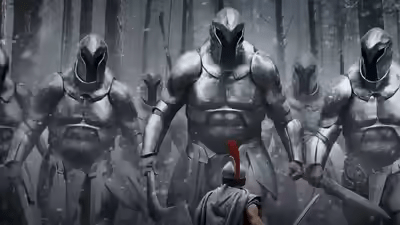
This scene was the only part of the Greek myths/stories that I’d never come across before (or forgot about). These are called “Laestrygonians“, who are a mythical tribe of giants. These added some humour to the story, while also having a catastrophic impact on the soldier’s journey (and meeting their end, for many). Apparently the Odyssey poem is quite comedic in parts, and flamboyant as an epic, a ballad almost. This scene is perhaps the most notable to be “comedic”. The laughing child which is a giant, so it looked like an adult at first. Asking where their parents were once they realised it was a child, and then being chased through the trees but giant silver men. It’s funny!
However, not as funny as some viewers may have wanted who appreciate the original source material. Remember, adaptation is about adapting. It’s someone’s take on the source material. Nolan did his version of this epic, twisty tale, and in my opinion, it was near flawless.
The dog
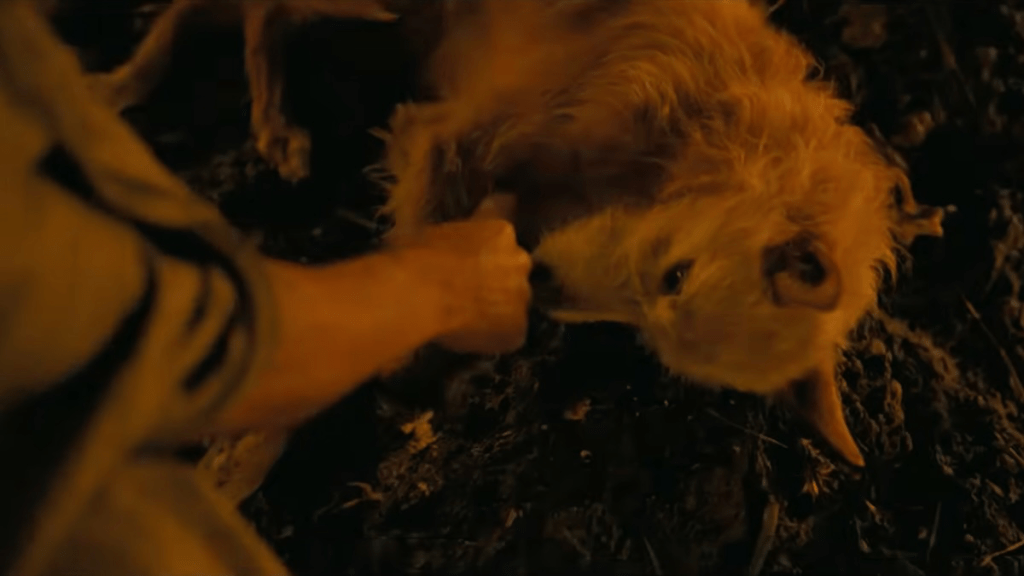
My heart! I’m a dog lover and dog mom. Any film with a dog in it gets me to tears. The fact that the dog waited 20 years for its master is just exceptionally emotive. That he died as soon as Odysseus returned. The abuse the dog suffered at the hands (and feet) of the suitors in their home was horrific to watch and was perfectly employed as a device to separate the “good people” and the “bad people”.
Or rather, the moral centre of the narrative: how we treat others, especially those we deem beneath us.
Circe scene
This was one of my favourite scenes, if not my top scene. I vaguely know Circe as a character in Greek myth, but haven’t experienced her in depth. I knew she was a witch, but not what her role would be or how her magic would be employed. It was gross and brilliant!
Anyone can easily show a shapeshifting men these days with CGI, but Nolan went deeper. He had her pulling at this faces, moulding them like clay. It was both awful and beautiful to watch. As a fantasy writer, I love this level of detail, attention paid to how the magic is used, not just the aftermath.
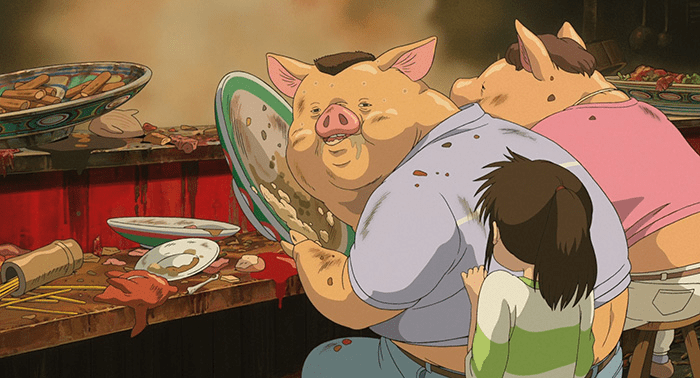
Reminiscent of the scene in Spirited Away with the parents engorging themselves and transforming into pigs, I loved this idea of gluttony portrayed on screen. How we are so unsatisfied with everything, that we are beasts.
Plus, Circe represented the trauma women face in a world dominated by men. How soldiers out on the battlefield often rape women and even children because they deem the areas they are conquering as other. The people as less-than. Circe is now an infinitely more interesting character in Greek myth to me, and so I’d like to read more about her.
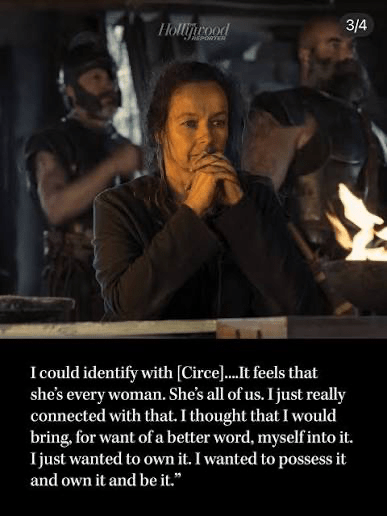
Exceptionally well-acted, emotional and harrowing scene from actress Samantha Morton who I know from watching the TV series Harlots.
Siren scene
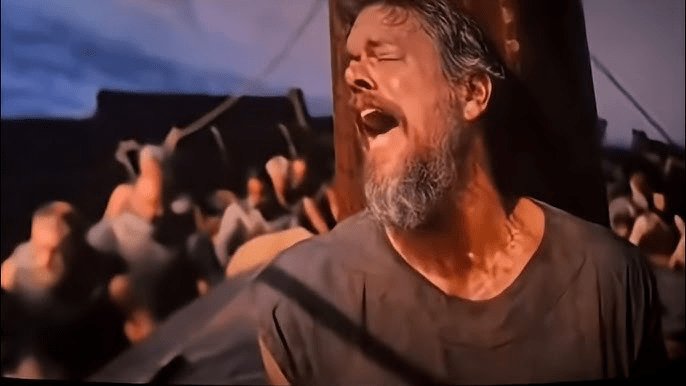
The nullification of sound when they put the wax in their ears was as brilliant as the use of sound in his epic film Oppenheimer. A small detail that had great effect. A siren as a mythical creature is widely known, though confused with mermaids, so they didn’t even have to show them. No need for CGI or computers to get the point across. All they needed was a fish tail flapping on a rock cloaked by an eerie mist and the effect was delivered. I think if we had seen them in full, it would have taken away from the scene. Sharp teeth or talents, breasts laced with scales, we’d end up focusing on the wrong thing. Instead, it was about their song.
The fact that Odysseus wanted to hear it shows a lot about his character:
- Fearlessness
- Daring
- Curiosity
- Superiority complex
- Fatal flaw
- Ambition
- Narcissism
Anyone well-versed in the story from the poem may interpret his character differently, but I see him as very layered. He was brilliant, but deeply flawed.
Also, this was one line that made me laugh in the cinema. Something like he wanting to do it because no other man had heard it. Like a dare, almost. A playfulness to his curiosity quickly stomped out by the reality of the hearing the song.
IT was also a unique take on a siren song in my experience. That it was about all the things you want but don’t have; the things you chase and never will obtain; the things you failed at; the choices you made. That the men aren’t lured to the sirens out of lust, thus being drowned for their hunger, but instead their inner failings. That men seek the sirens, perhaps, to end their suffering.
Calypso scenes
Not much to say here really. I knew about the lotus flower from Percy Jackson; that they were keeping him there, lost in time. I loved the dreamy effect of how it was shot. Like he could have been in Heaven or Purgatory. That it may have been his imagination. Not knowing what’s real or not. This was well done. It was used as a tool for telling the framed narrative. He slowly comes to unravel his memories, telling the story to Calypso and experiencing the aftermath of the past.
That he then had to give in to the gods, be out of control, was poignant. A rounding of his character that he faces his punishment, must only reach home when being at the mercy of the gods he wronged.
I think in the original it’s supposed to be more of a romantic relationship; sexual in nature? That Odysseus has a sexual relationship with Circe too. However, this still landed well for me. That she loved him but realised it was Stockholm Syndrome almost. A love for your captor, your saviour. Not real.
Role of Athena
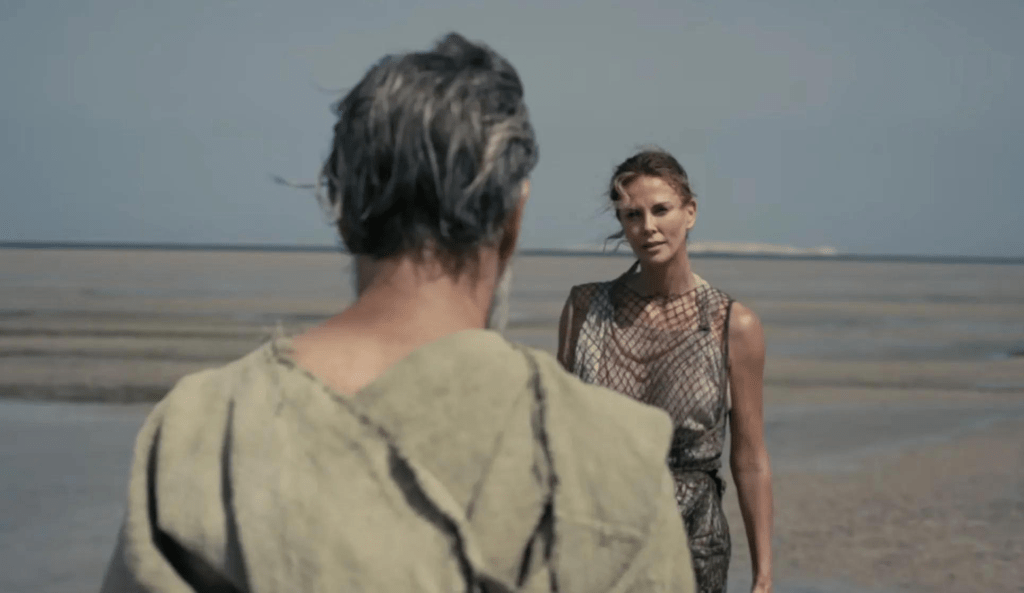
I didn’t realise that Zendaya as Athena would be a mostly ghostly role. That she is stalking his consciousness as a reminder of what he did and what he has been avoiding in his escape with Calypso. The story culminates with his confession that they were the “people from the sea” who broke Zeus’s Law with the Trojan horse.
Athena’s statue was beheaded during the attack on Troy. This was a direct and deliberate attack on the gods. She is the goddess of war strategy, and so she being the one to haunt him is important. That his strategy wasn’t fair or just.
She is dressed in beige robes to show her cleanliness and purity. Her head covered for modesty and almost protection. This is in contrast to his dark colours are armour for the majority of these scenes together until he is old and then faces his mistake and journeys to fix it.
The Gods as metaphor, punishment, nature
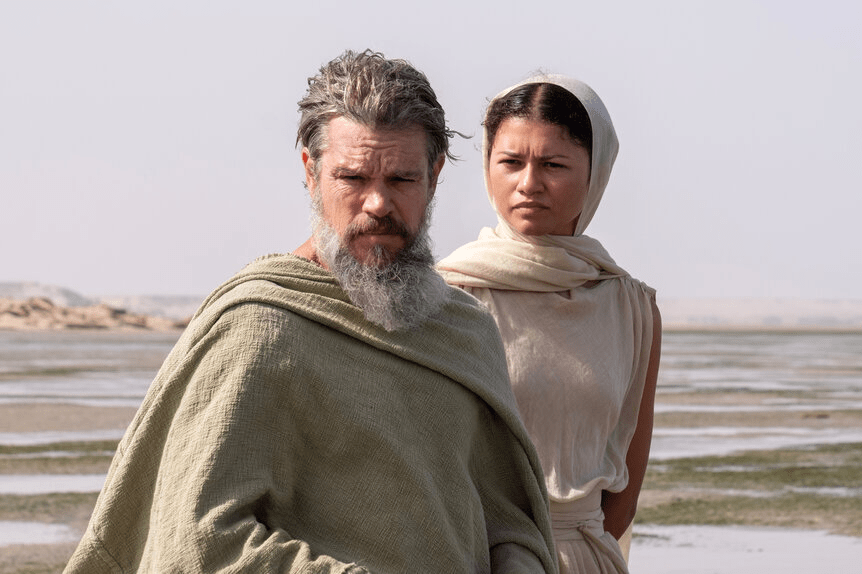
Unlike Athena, Zeus and Poseidon are not anthropomorphised. Instead, they are seen in nature only: the howling winds, strike of lightning, the roaring sea. This was effective for me. We didn’t need these gods portrayed as men because the attack of nature is more powerful. Most of us see the “effects of a god’s judgment” through natural, normal events. They could recognise the messages or actions of the gods without having to meet them in human (or ghostly) form.
The gods each put him through trials as punishment but also as redirection towards a moral path or rebirth. An awakening and realising his mistake. His men gave into the warning about Apollo’s cattle, and that was their undoing, but Odysseus takes it as a personal failing. That his duty is to protect them from themselves, as Athena notes. But this is incorrect, and a character flaw on his part, though noble and understandable.
Calypso and Circe both point out that he needs to heed the gods. Face them. See what their actions are trying to teach him, not fight them. But he doesn’t listen, and therefore he ends up alone and stranded and has forgotten his trials.
Interestingly, the females give warnings and mercy while the male gods just deliver punishment without explanation or remorse.
Zeus’s law
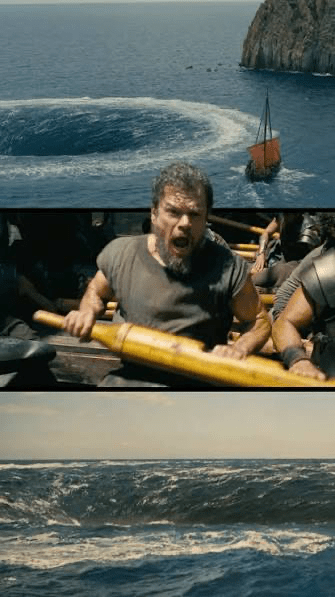
The whole film centres around Zeus’s law, the law that you must treat all visitors with kindness and hospitality, as they may be a god in disguise (in a nutshell). Although this was repeated perhaps too many times, I adore this idea. It’s something that now, three thousand years later, is still important:
How we treat our fellow man, regardless of their status
It was very clever that the twist ended in he and his men being the ones to betray Zeus’s Law and defy the gods. That they were the omen amidst the rumours since Troy (the people from the sea).
I think that it’s a beautiful message of empathy and the power of hospitality. That it shows a man’s true character to treat others, even beggars, with kindness and respect. That it takes nothing to share and give the gift of food. Holland’s character versus Pattinson’s were the character foils used to demonstrate this.
Hades scene
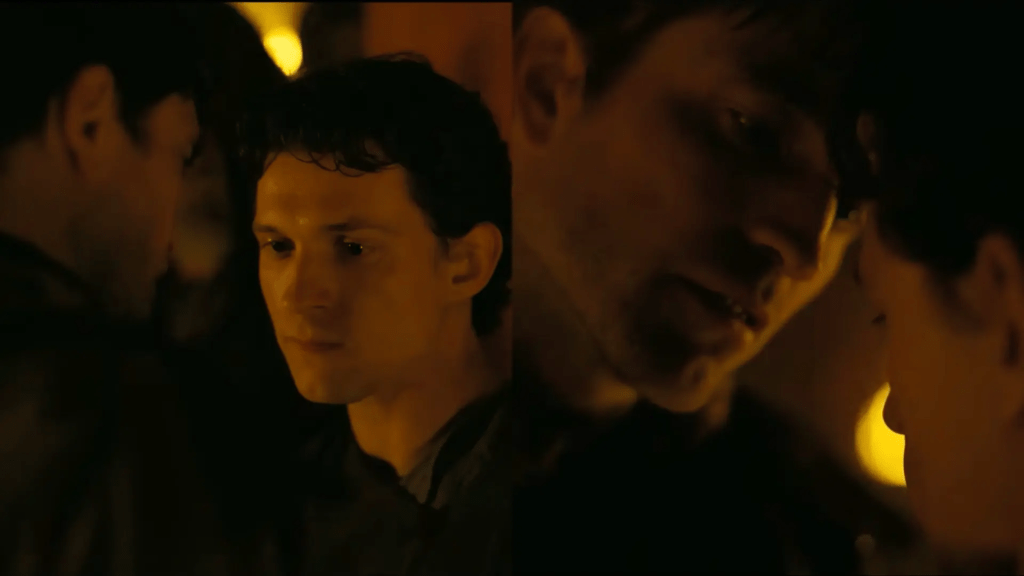
The ghosts in this scene were perfect. Haunting and unique. They rose from the ground in a very typical way but the messaging was still effective. That the men lost while fighting another man’s battle are still there, harbouring regrets and rage and a life unlived.
Elliott Page as Sinon was especially powerful. Giving the lock/stick to Odysseus for him to deliver to Pattinson’s character, who was a coward. The crawling of Sinon along the beach, hurt and pained and angry, was a strong image. His lament. The burden of regret on Odysseus.
Hades as a gross almost demonic being on the ground was also fantastic. The blood on the shield a metaphor for the loss and sacrifice already made during battle. How the warnings and prophecy almost was given and came to pass. The men storming the beach in pursuit of them, as if still in battle.
Telemachus & Penelope’s role
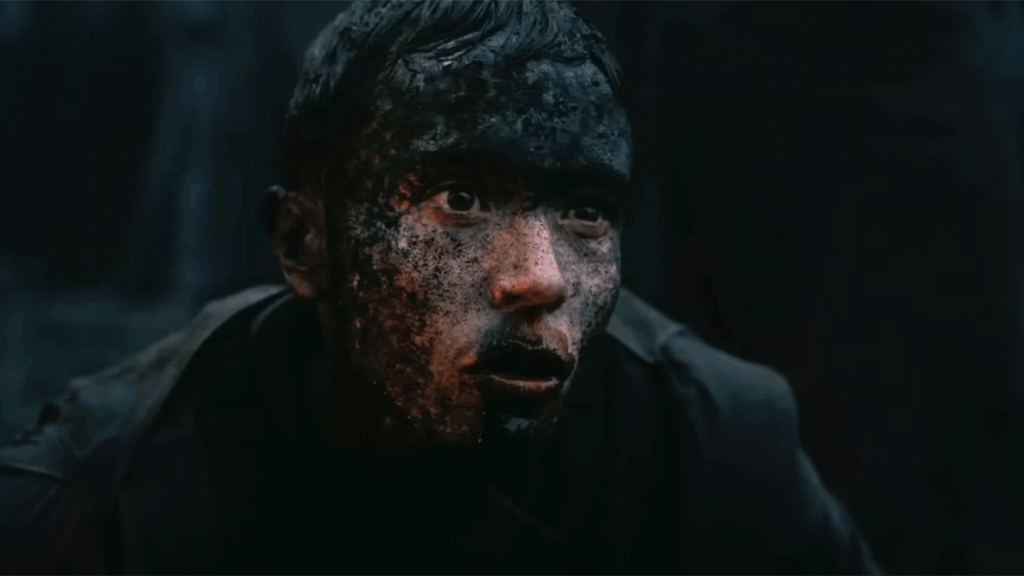
These had quieter roles but were still poignant. Holland as Odysseus’s son had the role of forwarding the storytelling. By visiting Sparta to find his dad, he was able to hear the story of his victory thus allowing the audience to witness it too. A son who is but a boy, afraid and alone in uncertain times after being abandoned by his father, who everyone regards as a hero but he can’t be sure. He needs to know. He needs closure and this is emotional, especially seen when he’s speaking to Menelaus (played by Jon Bernthal). We witness through Telemachus the wreckage of war on a boy having to grow up without a dad, only a memory and rumours and songs of his life to grasp onto.
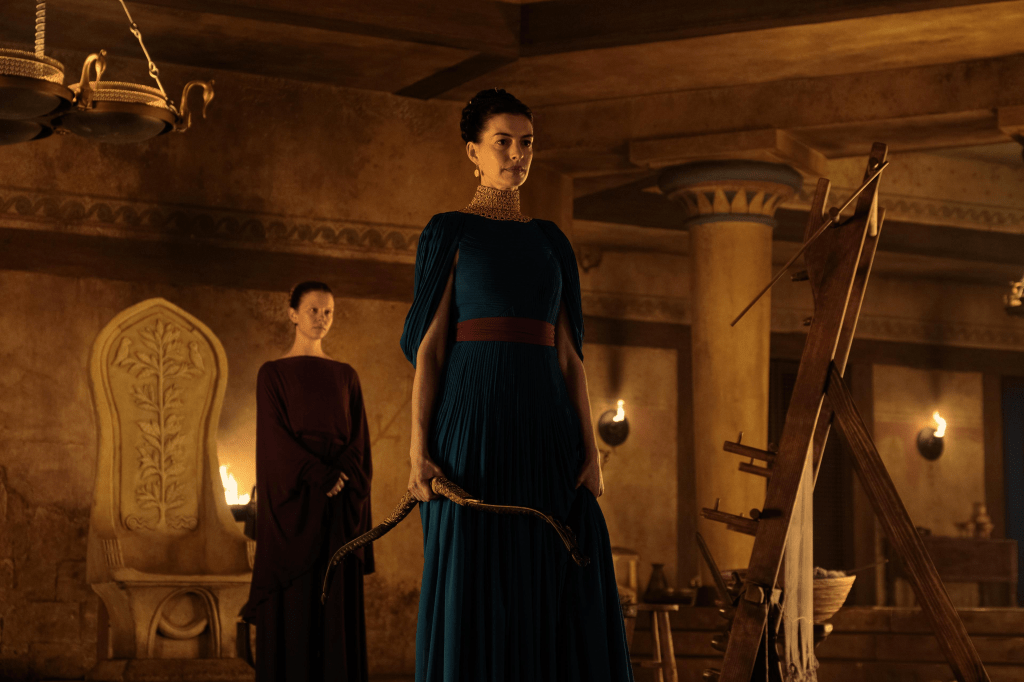
Penelope, Odysseus’s wife, was behind a veil for most of the film, creating an effect of godliness; detached from lesser society or earthly beings. Is she the epitome of honour and grace? The symbol of what others should aspire to be?
She is a loyal wife and is punished for this almost by having to house those rude, brutish suitors in her home. They abused her hospitality, which is important regarding Zeus’s Law, as discussed above. She was very clever in her trial decision, and this was an excellent way for the reveal of Odysseus’s return. She was right in what she said to her son and her husband and the situation that befell her was a difficult one that she handled as best she could. Hathaway delivered an emotive performance.
It also must be remembered that she was the one to give Odysseus the Athena figurine that he carried through the battle. He then abused that idea by going against Athena, as aforementioned. But he kept the figure; his tie to both Penelope and Athena. This is crucial. It means he was never truly lost for good, only astray.
Nit-picking critique
- I’d have liked more intimacy between the soldiers who go through this harrowing journey together; more brotherhood and emotion and playfulness
- More Lupita Nyong’o! Would have been great if she had a bigger role as such a strong actor
- More playfulness in general perhaps, but this was a haunting tale and landed as such, regardless of original intentions of the source material
If you want an expert/academic critique of the film from those who are well-versed in the poem and it’s adaptation, watch this:
The lack of humour for the character Odysseus and certain scenes seems to be the critique that I ponder after watching this.


One thought on “Spoiler Review of Christopher Nolan’s The Odyssey – A Masterclass in Storytelling!”