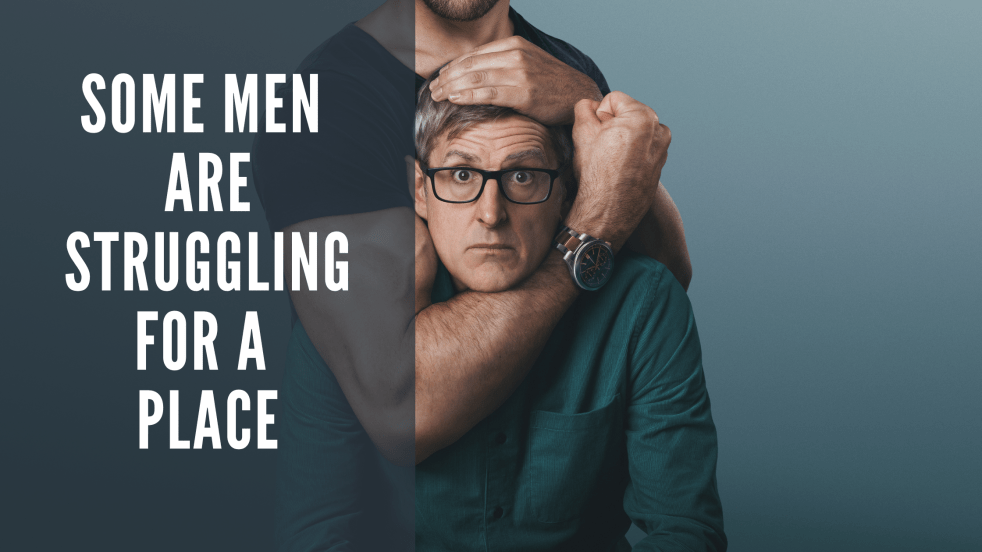
Everyone is talking about Louis Theroux’s latest documentary: Inside the Manosphere and I wanted to add my own thoughts. Firstly, it was an important watch. It highlighted the popular men online who are corrupting and influencing today’s vulnerable men and youth. If you are a parent of boys or male yourself, this is good to know.
Secondly, I felt it didn’t achieve what I hoped it would. Myself and my husband were talking during and after, and we feel it missed a crucial opportunity to critique the Manosphere and it’s impact. It simply highlighted a echo chamber, a warped view of the world, an extreme-leaning misogyny for views, wealth, and power. However, it didn’t dig into how these men got to this point; why they feel they need it; the affect it’s having on today’s youth; and the very dangerous implications of this ideology which is, as we saw, popular now.
Thirdly, these men often made great points, but fell into the wrong ideology promising flawed or downright dangerous answers. They didn’t seem to realise that they had become the enemy they were demonising. Instead of helping little boys who were struggling like they were, they are using them for their own capitalistic gain. And so, perpetuating a cycle that they themselves are victims of.
I hesitate to talk about masculinity too must on my blog because as a friend said to me, sadly, men who are thinking this way will not be swayed to the alternative by a woman. They will think we don’t understand their needs. And I can see that. It’s unfortunate, but it makes logical sense. This is why my firm belief is that men and boys need other men and boys who are healthy role models of masculinity, but more so, of just being a good, well-rounded, individual.
Signs of unhealthy masculinity
- Blaming problems on an unnamed, vague group e.g. The Jews, The Matrix, The Trans-Agenda, Feminists
- Working on one’s physique only over any mental or emotional work
- Speaking like one is following a script / mimicking the ideology they witness online from “successful” men
- Believing men should control, dictate to, or have power over women
- A glorification and nostalgic romanticisation of traditional values and gender roles
- Dehumanising of women / objectification of women
- Jokes about women, girls, trans folks or gay men – an almost fixation on blaming these groups or bullying and belittling them
Warning signs / vulnerable groups to this ideology:
- Lonely boys and men (haven’t got friends, or a group, or a community)
- Unemployment / poverty / homelessness
- Childhood trauma – especially regarding absent or toxic father figures or complex relationships with mothers
- Bullied at a young age
- Just got out of a relationship / hurt from a relationship with a woman in the past
- Overweight men or with low self-esteem
- Western men
- Boys chronically online with no connections in real life
- Men who haven’t ever had sex or have had a lot of rejection from women for sex
- Closeted or abused homosexual men
TV and Film Reps of Healthy Masculinity/ Masculine Relationships
I wanted to be able to point to something and say, “this, this is what masculinity should be” and so I tried to come up with a few examples that I’ve witnessed myself. For me, healthy masculinity and healthy relationships between men involve:
- Open and honest safe spaces
- Freedom to show emotion
- Caring about things and using one’s passion
- Strength – inner, outer, discipline, fairness, choosing the harder option like forgiveness or kindness when anger or rudeness is easier, protecting one’s loved ones but allowing them space to breathe and not be solely dependent on you
- Supportive
- Elevates the voices, choices, and experiences of women and other non-binary folks
- A present father
My first example is Uncle Phill and Will from The Fresh Prince of Bel-air. The reason I chose this one was because of this scene:
I cry every time because this scene is everything. I shows how important a father is to a boy. It shows the turmoil a boy feels when he’s trying not to feel his emotions. That urge to “man up” and get over it and “be strong” and move on. Then the inevitable, and important, emotional release. Then noticing and verbalising the core feeling/trauma, “how come he don’t want me, man?” which is the pain inside a lot of boys and men (not in these exact words). Then what Will has that a lot of other boys and men doesn’t have is Uncle Phill. Who gave him the space to process his thoughts and emotions then held him when he let it out.
Next is The Last of Us game and TV show. I won’t go into this one as much, because I think this video just about sums it up when I watched it last year:
Lastly, Brooklyn 99 with main characters Terry, Holt, Boyle and Jake. Each of these men express themselves and their masculinity in different, well-balanced ways. Terry is the typical alpha male in physique (something the Manosphere would aspire towards) but is a huge softy. He is a present and caring father of 3 girls. He’s a devoted husband. He drives a mini van, likes to paint and draw, reads fantasy novels, and eats yogurt. He talks about exercise and diet, but never as something inherently masculine. He also openly speaks about therapy and his emotionally abusive father in the show (which was based on his real life).
Holt is a leader (as police captain of their precinct) and he has a stoic, imperturbable exterior. He is disciplined, firm and fair, and well-presented in his demeanour, dress and idiosyncrasies. He is also a gay man. Homosexuality does not in any way reduce his masculinity, his power, his influence, or his strength. He is respected by the whole team and wider world. The show doesn’t shy away from highlighting his difficulty as a gay black man in the NYPD however. This is important. They show that he has overcome hurdles. He has stayed true to himself. With the support of his team, which he lets in to become a surrogate family within the police force that he never used to have, helps him to keep strong. He also has a great character arc of learning from the others in the team to be more playful and open.

Lastly, Boyle and Jake. Firstly, their relationship is so lovely and hilarious! Boyle is a softer character, who is accidentally sexual in his language, likes to cook and eat, and is a “beta” who lets others take the lead. He is also a brilliant cop, has the respect and support of his team when it matters most, and is a present father. He is the glue of the group.
Jake is our MC at the centre of most narratives. He is a man with “arrested development” in that his childhood trauma (absent father who cheated on his mother) causes him to act immature and seek father figures. He has called both Captain Holt and Terry “dad” at times, because he wants to make a father figure proud. We learn about feminist issues through Jake at times, like with the “He Said, She Said” episode in season 6, episode 8. Jake’s relationship with Type-A studious Amy means he is becoming more mature, well-balanced, and understanding of the complexities of the world. While old Jake may make jokes, get angry, or run from discomfort, he now learns from it and even educates others.
This is all to say that this show (and I’m sure many others) are highlighting the variety of masculine characters in the world. That we don’t need one set idea of what a man is supposed to be. Men are complex and varied. They express themselves (physically or emotionally) in different ways. They make mistakes; they learn and grow and change. They are human beings: fluid, vulnerable, adapting, trying.
It was messy to begin with, right?
Traditional gender roles and ideology in the West is, and always was, flawed. “Feminine skills and roles” are life skills – cooking, cleaning, nurturing the young, growth, patience, emotional regulation. It’s not weak, feminine or gay to have these skills; it’s a matter of survival and self-reliance! “Male skills and roles” are also life skills – self-reliance for financial stability, surviving if your car breaks down, being able to fight off an attacker etc. There never should have been a separation of duties and skills, as it only set a lot of us up for failure, pain, and struggle.
Embrace all life skills!
The blending of roles and transference of skill sets shows that men and women and those in between the binary are simply learning that it never made sense to half your own skillset! To half your survival life skills. To make yourself dependent on others unnecessarily.
Similarly, dance and the arts are considered feminine to some, but art and bodily expression is innate! It’s a human, emotive reaction. An impulse; an instinct. Natural! Babies do it. It’s something that we are conditioned to feel shame about; to suppress or hide. But it was self-expression and natural and human before society tries to tell us what is and isn’t okay.
What men may need now
These are some of my ideas for combating the Manospehere. This is not an exhaustive list and is, of course, my own opinion and experiences of men I know or see online.
Men need sport / a team / an outlet = community and healthy self expression. Call it testosterone, or just the fact that EVERYONE benefits from exercise and socialising, but I believe healthy sports teams are crucial to making a healthy boy/man. My husband’s closest friends were found through playing American Football in 2019. He then began playing Call of Duty online with these friends, so even when lockdown hit or various members stopped playing, they could keep in touch. This online game (and the physical sport) is also a means of getting out aggression, having playful banter, and catching up with friends in a way that feels easy and safe. I’ve heard them talk about all sorts of vulnerable things while playing the game. This group of friends supports one another. My husband even goes to watch his friend play football sometimes! This makes my heart so happy!
Boys need healthy role models. This is obvious and has been touched on but if they are only seeing the likes of HS Tikky whatever and A.T. online, they will believe this is how a man is supposed to be. They need alternatives. They need to see other standards of masculinity and male success to aspire to. It’s provides them with a blueprint, really. Monkey see, monkey do, after all.
Boys and men need females in their lives. This isn’t just about men helping men/boys, just like female issues isn’t just for females to tackle. It’s all of us. Women need to be careful of the language they are using, how they are treating their male partners in front of their children (in mix-sex partnerships), and how they treat their differently gendered children. For example, you can’t say that the girl should sit still and play with the tea set while the boy goes outside in the mud. You shouldn’t say “you’re the man of the house now” when their dad leaves. You are a crucial part of how they view women, how they view their sister, how they treat their peers. Your language, no matter how trivial you may think it is, becomes their inner voice.
Scary concept!
It’s a lot of pressure being a parent and no one gets it 100% right. I mean, there’s a reason I’m not a mom yet. It’s bloody hard. But we have a duty not only to our own children but the wider world to be mindful of how we are raising our boys. The last thing we want is for them to become predators. For them to become abusers.
Men need third spaces. Lastly, similar to my first point, they need something other than home and work (places where a lot of us are wearing masks and putting on a performance e.g. being a good dad or a good employee seeking promotion). This is an issue for all of us in individualistic societies and modern living, especially working from home, because we become lonely and lose parts of ourselves. Our whole world is reduced to two buildings (for some, just one). Instead, people need a third (or fourth, or fifth) space to visit regularly.
- Sports teams practices
- Fitness classes or groups
- Bookclub
- Library
- Local regular coffeeshop / cafe
- A local regular restaurant or takeaway where you know the owners
- A class / higher education course in person
- Youth groups
- Knitting group; board games group; film club; arts group; wellness group; and so on
Just a place for likeminded individuals to visit regularly so they have a community, a safe space, a place to decompress and be themselves.
Resources for struggling men and parents of males
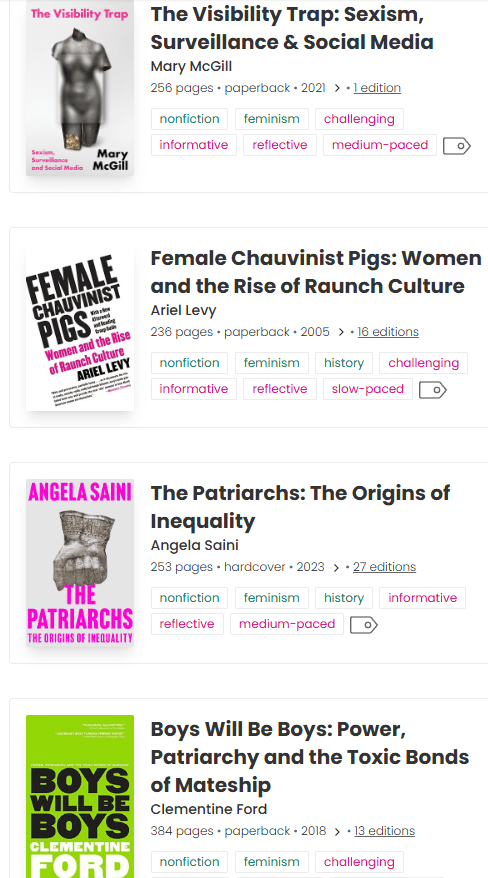
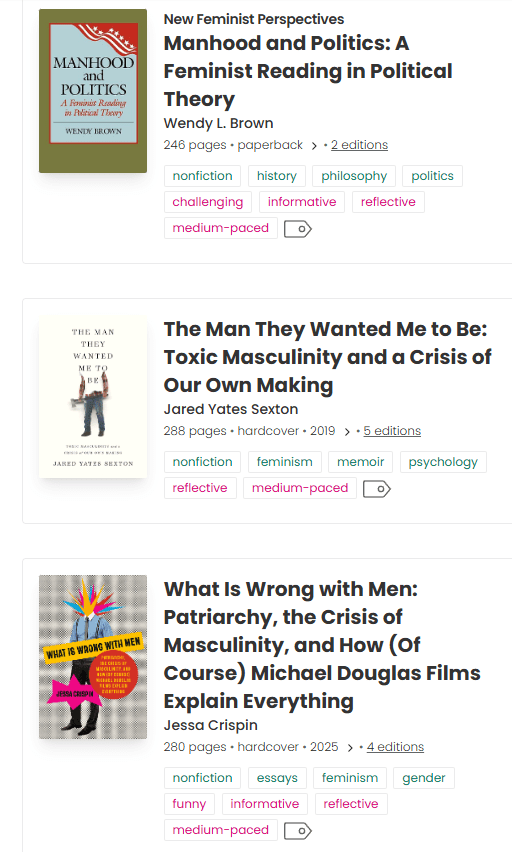
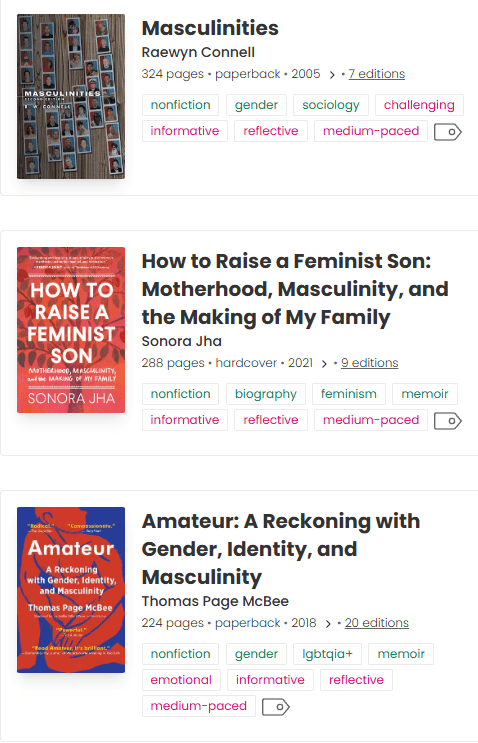
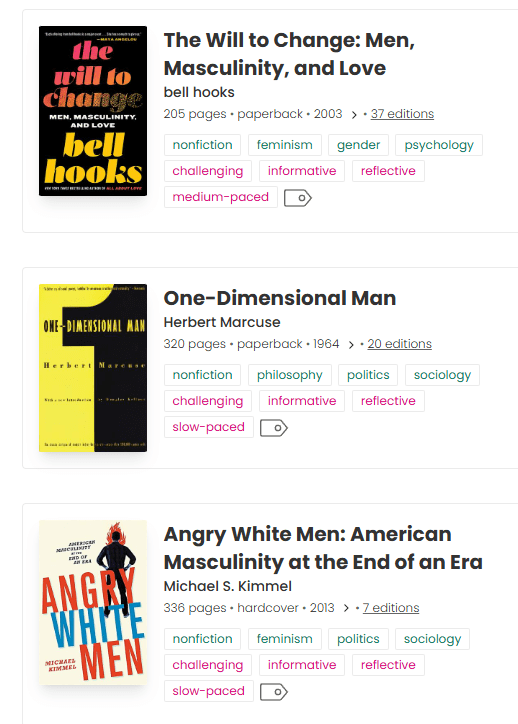
Here are some interesting videos on masculinity if you’re curious on thoughts from men:
- Book rec: Clown World: Four Years Inside Andrew Tate’s Manosphere by Matt Shea and Jamie Tahsin
- Is There a Masculinity Crisis?
- The Masculinity Crisis: What’s Really Happening?
- A New Vision on Healthy Masculinity
- A balanced argument (by a woman who interviewed men)
- Matthew McConaughey on Masculinity and the MeToo Movement
An educated conversation and a well-balanced TV view:
Polanski’s podcast is a great listen that I’ve recently found, and in this episode with Jimmy The Giant, they discuss immigration, divide between the left and right, and masculinity alongside trans rights being human rights.
Emmy award-winning Adolescence TV show on Netflix
Trigger warnings: Steve film on Netflix with Cillian Murphy
For masculinity, raising young boys into men, and the masculinity issues of today:
Letters to Our Sons – research and support for young boys
Dad La Soul – support network for dads to beat social isolation
Avoidance, Drugs, Heartbreak and Dogs by Jordan Stephens (book on masculinity and neurodivergence)
Clown World: Four Years Inside Andrew Tate’s Manosphere by Matt Shea and Jamie Tahsin (book on masculinity and the reality of Andrew Tate)
Shy by Max Porter (the book the film Steve with Cillain Murphy is based on)
Rejection by Tony Tulathimutte (short story collection tackling real issues and not just masculinity but touches on that)
Boys Don’t Try: Rethinking Masculinity in Schools by Mark Roberts and Matt Pinkett
Further reading: https://internetprincess.substack.com/p/capitalism-makes-women-of-us-all
Sincerely,
S. xx

 S. R. Crawford