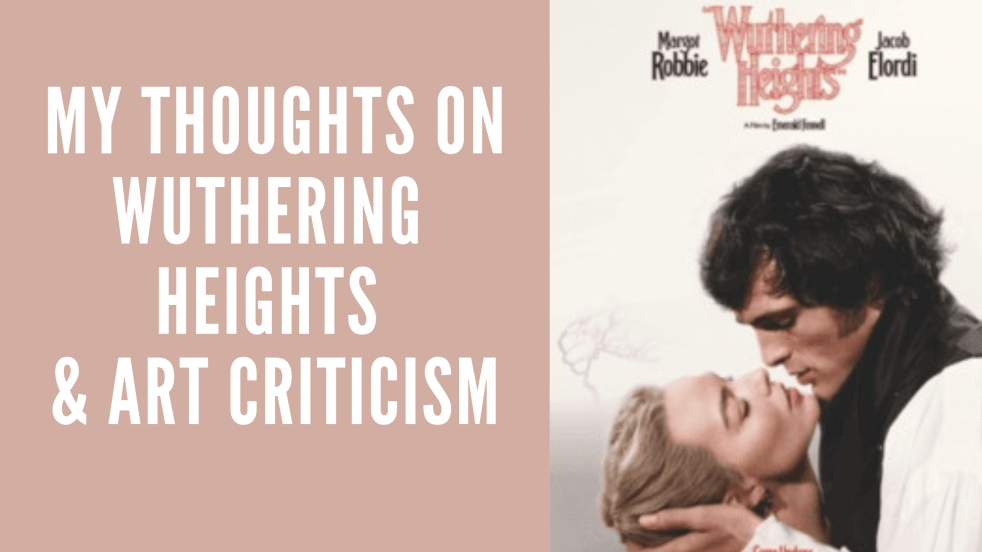
Withering Heights by Emerald Fennell (director of the raunchy Saltburn) has released another controversial film, this time tackling a classic more head-on. Fans of the 1849 classic by Emily Bronte are up in arms (and quite rightly so, it seems) about the adaptation, but I myself haven’t read the original source material or watched other versions of the film.
My initial reaction/ thoughts:
Critical views:
A look at “adaptation” as a concept
Adaptation ” involves reinterpreting original works, often altering the medium, format, or even the narrative style to create a new experience, such as turning a novel into a film or a play”; “transforming a story from one medium to another, often with significant changes to fit the new format”.
To “adapt” is to change.
It’s a form of translation from text to screen. In every translation, something is lost because it doesn’t always fit neatly into the new language or form of adaptation. When adapting in this way, the creators of the screen adaptation can take creative license in bringing the text to life in a new way. Fitting something to screen doesn’t always work well. It has to change shape to achieve something. Sometimes that thing the creator is trying to achieve is a fresh take on the original source material.
Another thing to consider is that when we each read a book or even watch a film, we interpret it differently depending on who we are as a person and how we feel when we consume that piece of media. In a way, we don’t all read the same book, even when reading the same book! What it means to us, what we feel it is saying, how it’s delivered and our feelings toward it will all differ. Therefore, someone’s adaptation of that story will differ, too, based on what they found most compelling. If 5 people were given the assignment of adapting Wuthering Heights to screen for 2026, we may get 5 very different films.
Let’s think about different versions of adaptation:
REMAKE – “adaptation that attempts to replicate the success of an original film, often with new elements to fit the new format.”
REBOOT – “restart or revive (a process or sequence, especially a series of films or television programmes); give fresh impetus to”
RETELLING – “maintains the core essence and plot of the source material while presenting it in a fresh way, often through updates in language, perspective, or cultural context.”
REIMAGINING – “Modern reimaginings transplant a classic story into a contemporary setting, using its themes to speak to today’s world. This approach can make old stories feel immediate and relevant, especially when tackling issues that resonate across centuries: power, love, injustice, revolution.”
BASED ON – “in film generally means that a story or character is developed from real events, facts, or other works…
can imply that the film may include creative liberties, such as characterizations or timelines, to enhance the storytelling.”
FAITHFUL ADAPTATION – “refers to the degree to which an adaptation honors the source material—be it a novel, play, or even a video game—while also making necessary adjustments for the unique demands of cinema.”
CREATIVE/ARTISTIC LICENSE – “refers to the freedom creators take to deviate from factual accuracy or original material to enhance storytelling. In the case of adaptations, this often involves reinterpreting a source work, such as a novel transformed into a film, where key elements may be altered to fit the visual medium or current societal contexts.”
Definitions from this section found here: https://bromundlaw.com/literature/adaptation-vs-retelling , https://whatcanu.com/the-art-of-adaptation-how-faithful-should-movie-adaptations-be/ , and https://nottinghamplayhouse.co.uk/news/8-reimagining-classics-approaches-to-stage-adaptation
This is all to say that it’s not as simple as it was “good” or it was “bad”. Or the book was better. Or it wasn’t the book. This misses the nuance of a more complex and thoughtful analysis of media, art, storytelling, adaptation, and artistic intentions. We do ourselves, our brains, and creators a disservice to limit our thoughts to good and bad. To not take some time to think more deeply about something we have consumed, the context it sits in, and what it achieved or didn’t achieve, it’s purpose, genre, target audience etc.
Think more critically about the art you consume!! It takes more time but it’s worth it!
For a longer, more critical look at the film: The Casual Racism of Fennell’s “Wuthering Heights” & Its Misinterpretation of Emily Brontë’s novel – YouTube
Don’t forget to follow me on YouTube and Instagram for more videos!
Sincerely,
S. xx

 S. R. Crawford