Read parts one and two before reading this one, if you haven’t already.
Again, WARNING: this post is not for anyone who may be triggered by difficult conversations around gender identity.
The point of my three part essay on gender was to combat hate and provide a more nuanced view on gender for those who still feel they need to impose binaries and labels on other people. This last part is for me to share real world stories of trans, non-binary and LGTBQ+ folx, to educate those who haven’t taken the time to listen to their voices. I also try to offer a balance of honouring those who have detransitioned and their thoughts, alongside views and concerns of cisgendered people that may need addressing. I will then end with my final thoughts on gender identity.
Do you know what it feels like?
I believe that a lot of transphobia and confusion about non-binary individuals is due to ignorance. People simply don’t know what it’s like. So here I am sharing what it’s like for some…
Since writing my transphobia makes no sense post, I have had some feedback from trans people and I wanted to share with you what one amazing commenter said about trans men and their place in society. So here is there comment which I think we all need to read:
“There are some good points here but a huge, fundamental flaw in that you believe people have no problem with trans men — this is woefully misguided. One of the best sleights of hand the anti-trans lobby are performing is the systematic invisibilisation and erasure of trans men. That isn’t because we’re accepted. When we’re talked about, it’s usually in highly derogatory, misogynistic terms (“vapid victims”, “silly little girls who don’t know their own minds”, “easily led by friends and TikTok trends”). In the same way that trans women are hypervisibilised to create the fear necessary to remove cultural freedoms from everyone (especially gay rights), trans men are erased and invisibilised so bodily autonomy rights can be removed (especially from cis women, e.g. abortion, contraception, etc). Making a big fuss about trans women creates an extremely helpful smokescreen to removing rights from 50% of the population, which they are doing primarily through trans men. The Cass Review particularly focused on a narrative of “confused little girls” (often “with autism”), desperate to escape patriarchy, misled by doctors, joining in with fashion & their friends, devastatingly losing precious breasts and wombs — this is why! What we, as the trans community, SHOULD be doing is visibilising ALL those that the anti-trans lobby seeks to invisibilise. And yet I see, again and again, consent from members of our own community to erasing trans men further. I agree with your points about a perceived crisis in masculinity, including the sense that “real men” are being lost, but if you think for one minute that trans men tick that box for ‘them’, I’ve got a bridge to sell you. In short, please educate yourself better about trans men.”
Further watches if you’re interested:
https://youtu.be/YXUOxuKo2t0?si=zfY_i8p7YCv8F7MZ
https://youtu.be/THSVB6xSayI?si=c1SR8eYZlP9icQSF
https://youtu.be/AITRzvm0Xtg?si=JwGyH8WLUmmfdMaq
The importance of empathy above all else if you are cisgender
Any of us cisgendered people need to take a step back, be empathetic to, and aware of the following:
- Male sex, female sex, intersex versus gender identity
- Non-binary individuals and agendered individuals
- Transgender individuals
- Pronouns as a growing topic of discussion
- Social constructs across cultures informing gender norms
- Assumptions
- How they feel on the inside matters more than how you think they should feel
- Hair, clothing, makeup, interests as form of expression not biology
Some videos to watch on transphobia:
https://youtu.be/60B-NChtNiA?si=Ihg8i9MfyTYZb7gd
https://youtu.be/5RfARAuKdHM?si=wRe6rWbRvFe25g-V
https://youtu.be/yCxqdhZkxCo?si=kvWalqk_SbdVaLqw
What transgender individuals think about gender politics
I think it’s relatively easy to just let people express themselves in a way that they feel comfortable. I would hate for anyone to not feel comfortable in my presence. However, gender identity is critical for some people. It’s easy to not worry about gender – and perhaps have a narrow view, like I do, that we should just remove the labels that got us into this mess altogether – when it doesn’t affect you directly. For some, the terms they use, the way they dress, the rights and freedoms they are given are a daily worry and chore.
Let’s here some of these stories…
Detransititioners’ stories:
Chloe Cole detransitioning case and plea is aiming to protect trans children from a “poor medical system”. I agree with her to an extent. That she needed therapy and love and compassion at a time when she was most vulnerable. That she shouldn’t have been pushed to transition so young or be told that “becoming a boy would solve all her problems”. However, I don’t think we should take her plea (and that of many others like her) as a reason to neglect very real issues around gender identity in young people.
Could the answer be to protect children by supporting them through puberty, allowing a change in pronouns and dress only, and providing them with therapy until they are older? Sit beside them as a compassionate adult as they do research. Maybe speak to others like them with gender dysphoria?
Concerns of some cisgendered people / policy makers
- That transgender children are just afraid of puberty and their changing body
- That transgender people should use certain public toilets
- Fear of violence at women’s refuges (escaped domestic violence etc.)
- Trans athletes having an unfair advantage
- Against nature/God
- Definitions of transphobia and transmisia
- Educating children on trans people will make them trans
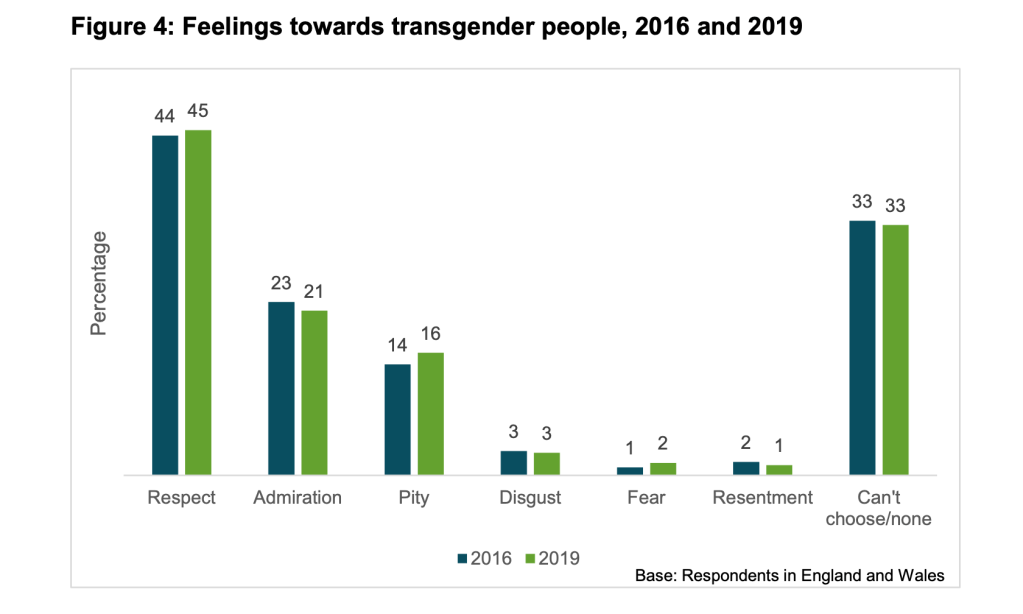
Equality and Human Rights found that: “Relatively few [interviewed on their thoughts of trans people] said they felt ‘disgust’ (3%), ‘fear’ (2%) or ‘resentment’ (1%)…Positive feelings were lowest among respondents in West Midlands [in England]…”
“Women were also more likely than men to feel admiration (26% and 17%). Men were more likely to say that they felt pity (18%) or disgust (5%), compared with women (14% and 1% respectively)“
Public toilets and women’s refuges
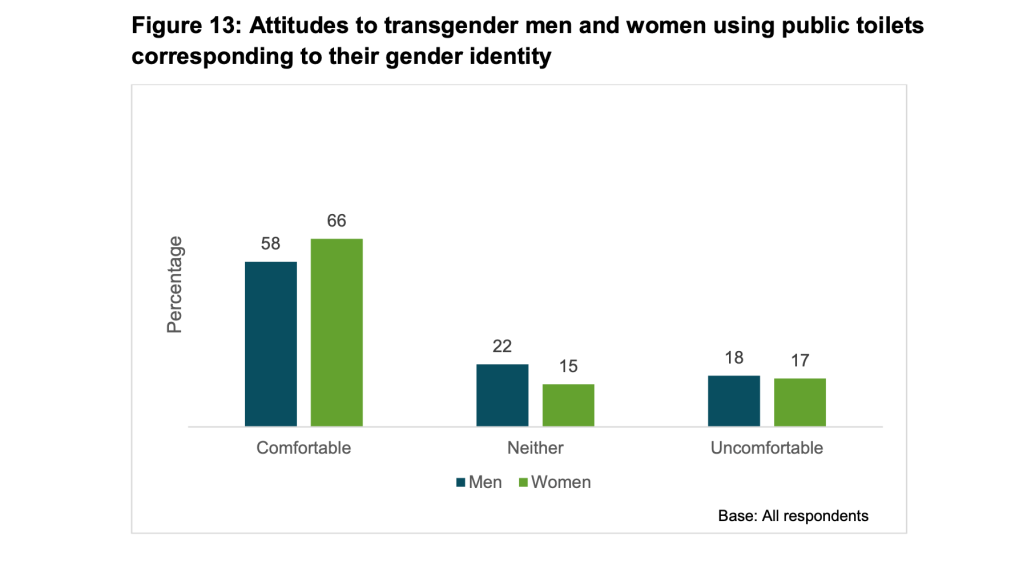
“Most women (66%) said they would be very or quite comfortable with this while 17% said they would be very or quite uncomfortable. A lower proportion of men (58%) said they would be very or quite comfortable with a transgender man using men’s public toilets, and 18% of men said they would feel very or quite uncomfortable.”
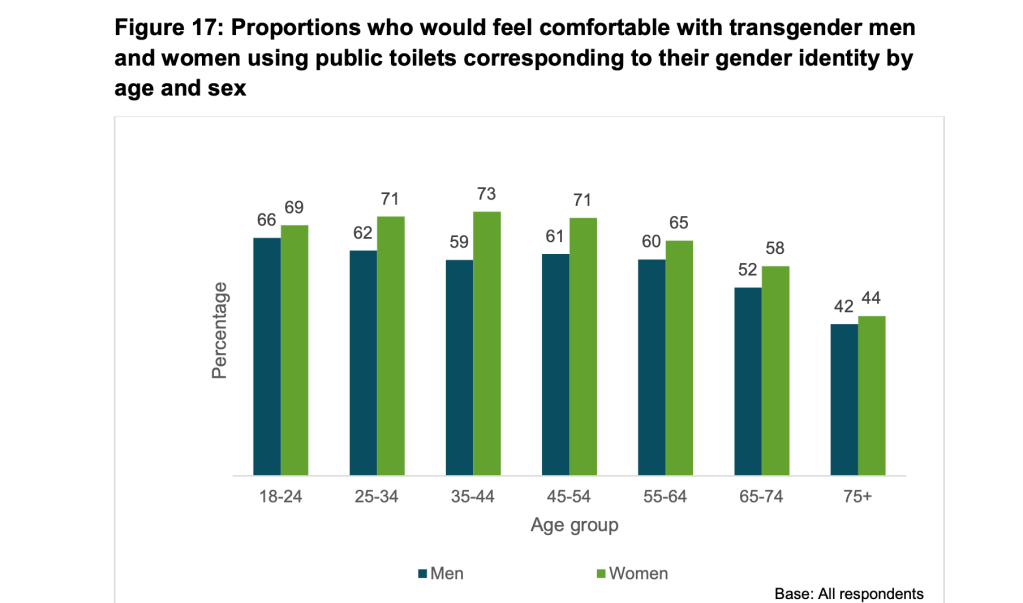
“More than two in five women (43%) who described themselves as a little prejudiced or very prejudiced against transgender people said they were uncomfortable with transgender women using women’s toilets, compared to 13% of those who said they were not prejudiced towards transgender people at all.“
“Women were slightly more likely to say they would feel uncomfortable about a transgender woman using a women’s refuge (22%), than a women’s public toilet (17%).”
Further reading:
https://yougov.co.uk/society/articles/43194-where-does-british-public-stand-transgender-rights-1
https://compass.onlinelibrary.wiley.com/doi/10.1111/soc4.70088
In sports:
I am going to admit that I am not sure how trans athletes ethically fit into mainstream sport. I believe and agree with trans athletes who state that biological and genetic variations exist in all of us. One biological woman may be small and naturally less muscular than another, but both would be legally allowed to compete against one another. Men are, mostly, more muscular or stronger than women, but there are also variations in men! My sister is stronger than the males in my family, that’s almost for certain! I, myself, have always been naturally very fast and strong/muscular. You could argue that I have a genetic advantage over other girls and women who have to work twice as hard as me to get to the same level.
Genetics vary in all of us by nature…so what’s actually “fair” here?
Censorship and Children’s Education
We do ourselves, and the next generation, a disservice by policing what can and can’t be accessed. Education needs to be wide-ranging, in-depth, and accessible for all. I do not believe in censorship. I do not believe we are protecting children by taking away their right to learn about trans and non-binary experiences.
I studied a Children’s Literature module for my degree and we touched on the topic of censorship. We read the young adult book Junk by Melvin Burgess, which was highly controversial at its time of publication for the exposure to drug abuse, sexual exploitation and sexual themes. However, Burgess and other critics highlighted that these things happen in the real world, so what’s wrong with writing about it? Children need to be given the space and tools to explore the texts they are exposed to safely, by adults supporting them with any questions or concerns they have, not deciding for them what they can and can’t read.
On Intersectionality
A lot of feminists don’t stand beside transwomen. Why? A lot of feminisms don’t march alongside black women. Why? This is called a lack of intersectionality.
Definition of intersectionality: “The term also refers more broadly to an intellectualframework for understanding how various aspects of individual identity—including race, gender, social class, and sexuality—interact to create unique experiences of privilege or oppression.“
If you are fighting for the rights of one but not the other, you are missing out on the whole. You are not making a fair world for women as a feminist if you are not making it fair and just for ALL women, even those outside your identity/group.
Similarly, you are not protecting all men but isolating, vilifying or rejecting gay men or transmen or feminine men or fluid men.
Pronouns, “72 Genders?” and Identity in Society
(Also available in podcast form here)
The absurd rhetoric that children are being taught “72 genders” is not factual. However, there are some resources out there listing many gender identities. There is contention about gender politics and gender being taught in schools. It seems there could be variations depending on boroughs and districts, but lately there has been changes to legislation on gender education. It suggests that schools “should not teach as fact that all people have a gender identity,” it also states that “schools should avoid using cartoons or diagrams that “oversimplify”, that could be interpreted as being aimed at younger children, or that perpetuate stereotypes or encourage pupils to question their gender.”
I have mixed feelings about this. I believe in education. I believe in transparency and inclusion and freedom of information etc. I don’t think we should “encourage” questioning of gender identity, but we should teach children that gender is a social construct at an age when they are likely to understand this. We could teach how other cultures view gender, like my part two post. My point is, we don’t need to talk in definitives, right? In absolutes and extremes and polarised ideas. We can teach them what’s out there, without forcing any child (or teen or anyone) to join a movement or something (which some people seem to think; that the left are using propaganda and extreme wokeism to indoctrinate children into some trans agenda and the erasure of masculinity…I strongly disagree).
It has also been said that “Schools already work hard to ensure that teaching is age-appropriate and this approach gives them the vital flexibility to respond to their own community and the needs of pupils in their schools,” which I agree with.
Consent is important. We can’t teach children without their parent/carers’ consent, but parents should be careful of policing what their children are exposed to too much. It will only lead to ignorance which is a dangerous society to live in. We need to protect children and teens who already identify outside the binaries or their biological sex. Poor education can mean these individuals are bullied by the other children simply because they don’t understand.
And we need to realise that we live in a modern, technological world where children are exposed to a plethora of information and sources online everyday. If we don’t provide them with education and sources that are legitimate and verified, then they are vulnerable to exposure to misinformation or disinformation that will do them more harm.
Pronouns may not mean anything to you, as a cisgendered individual, but it’s important for others. I wouldn’t assume a black person I met was Nigerian, for example, so I shouldn’t assume someone’s gender either. Just because you see something and may have an assumption, it’s key to be careful of stereotypes, bias, labelling, schemas, our own culture and past experiences to make a guess. Just ask!
Further reading:
https://pronouns.org/what-and-why and https://pronouns.org/how
https://www.lgbtqnation.com/2022/08/incomplete-list-gender-pronouns/
https://www.imdb.com/list/ls088717577/ – trans or non-binary actors
https://nonbinary.wiki/wiki/Notable_nonbinary_people
https://www.cosmopolitan.com/uk/love-sex/relationships/g39437356/non-binary-celebrities/
Gender issues I’m considering
(Without a definitive answer personally, for we should be careful of extremes and being too sure of anything! It’s good to consider things with education behind you and change your mind often as you learn more).
- How do we support potential trans children?
- Change pronouns without irreversible and damaging physical changes?
- Allow them space to consider their options and how they feel in their skin?
- Opportunities to consider more serious steps only after puberty?
- How do trans female athletes compete in sport fairly for all?
- How do we ensure trans people and cisgender people feel safe in the same bathrooms or changing rooms?
- Should it be free on the NHS to have surgeries for transitioning?
- Who has an authority over decisions on gender identity when it is mainly cisgendered individuals in positions of power in our government?
- Who are we harming more: those affected by gender politics personally, or an imagined future generation that we are brainwashing into gender woke politics? (okay, this last one is a no-brainer to me!)
It’s okay to question what’s best for our society. It’s how we grow and change. We have come a long way in supporting all expressions of gender identity by asking questions, allowing space for firsthand answers, and showing compassion.
Empathy above all else in discussing these issues is all I really ask from my readers
Book recommendations on gender identity and gender in general
(These are based on my interests / findings long before this post. I am not endorsing these books as I have not read the majority. They are my life-long “Gender Politics TBR”, as it were!)
For masculinity, raising young boys into men, and the masculinity issues of today:
Letters to Our Sons – research and support for young boys
Dad La Soul – support network for dads to beat social isolation
Avoidance, Drugs, Heartbreak and Dogs by Jordan Stephens (book on masculinity and neurodivergence)
Clown World: Four Years Inside Andrew Tate’s Manosphere by Matt Shea and Jamie Tahsin (book on masculinity and the reality of Andrew Tate)
Shy by Max Porter (the book the film Steve with Cillain Murphy is based on)
Rejection by Tony Tulathimutte (short story collection tackling real issues and not just masculinity but touches on that)
Boys Don’t Try: Rethinking Masculinity in Schools by Mark Roberts and Matt Pinkett
Feminism, gender identity, gender politics, transgender issues and other essays:
- Tomorrow Sex Will Be Good Again: Women and Desire in the Age of Consent by Katherine Angel
- The Selected Works of Audre Lorde
- The Gender Games by Juno Dawson
- This Book is Gay by Juno Dawson
- The Second Sex by Simone de Beauvoir
- Home Girls: A Black Feminist Anthology by Barbara Smith
- White Femininity: Race, Gender and Power by Katerina Deliovsky
- We Are Not Born Submissive: How Patriarchy Shapes Women’s Lives by Manon Garcia
- Before We Were Trans: A New History of Gender by Kit Heyam
- The Transgender Issue: An Argument for Justice by Shon Faye
- Trans: Exploring Gender Identity and Gender Dysphoria by Dr Az Hakeem
- Transmogrify!: 14 Fantastical Tales of Trans Magic by G. Haron Davis
- Female Fear Factory by Pumla Dineo Gqola
- Enemy Feminisms: TERFs, Policewomen, and Girlbosses Against Liberation by Sophie Lewis
- The Source of Self-Regard: Selected Essays, Speeches and Meditations by Toni Morrison
- Fugitive Feminism by Akwugo Emejulu
- Bone Black: Memories of Girlhood by Bell Hooks
- Men Who Hate Women: The Extremism Nobody is Talking About by Laura Bates
- Know My Name by Chanel Miller (trigger warning for sexual assault)
Let me know in the comments if you’ve read any of these or have others to recommend.
Lifting trans and non-binary voices
Here are some people I have come across myself who are either trans or non-binary themselves, or live outside the heteronormative limits of society, or are allies and advocates:
https://www.youtube.com/@PhilosophyTube – philosophy made entertaining
https://www.youtube.com/@WillowTalksBooks – booktuber I really enjoy
https://youtube.com/@_samanthalux?si=j56CO55hvOfUcImV – a new channel to me but I loved her perspective on the Emma Watson and J. K. Rowling conflict
Final thoughts and summary in the next post here.
Sincerely,
S. xx

 S. R. Crawford